Category: Civil Engineering

Welcome to our dedicated Civil Engineering hub. Here you will find a comprehensive collection of articles, tutorials, and case studies covering the vast spectrum of the civil discipline. Whether you are researching structural engineering principles, exploring modern construction management techniques, or looking for the latest trends in sustainable infrastructure, our resources are designed to help students and professionals stay ahead in the built environment.

  • Different types of Cracks in Concrete

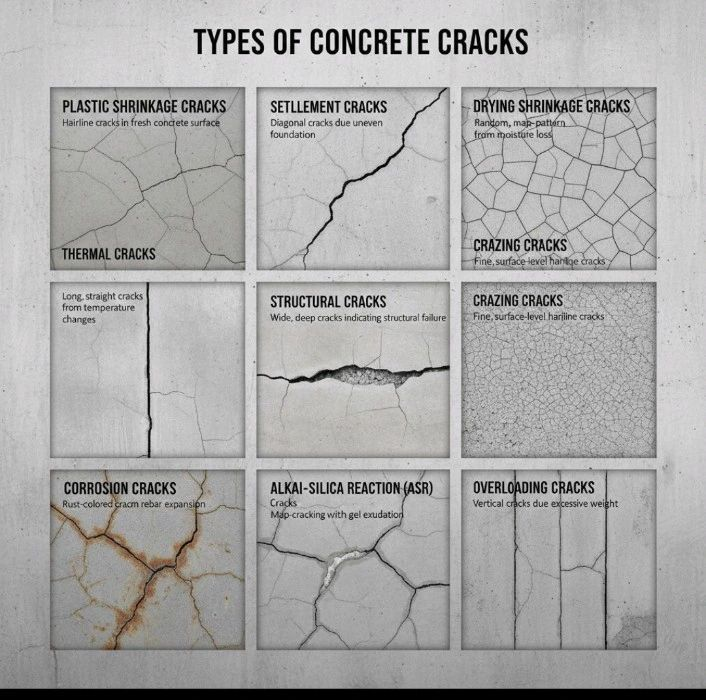
    Different types of Cracks in Concrete.


    1. Plastic Shrinkage Cracks Hairline cracks in fresh concrete surface due to rapid drying.

    2. Settlement Cracks – Diagonal cracks caused by uneven foundation settlement.

    3. Drying Shrinkage Cracks – Random, map-like cracks due to loss of moisture.

    4. Thermal Cracks – Long, straight cracks from temperature changes.

    5. Structural Cracks Wide and deep cracks indicating structural failure.

    6. Crazing Cracks Fine, surface-level hairline cracks (looks like a network).

    7. Corrosion Cracks Rust-colored cracks caused by expansion of corroded rebar (steel inside concrete).

    8. Alkali-Silica Reaction (ASR) Cracks – Map-pattern cracks with white gel due to chemical reaction inside concrete.

    9. Overloading Cracks – Vertical cracks formed due to excessive load or weight.

  • Development, Repair & Retrofitting Solutions for GOLF Course

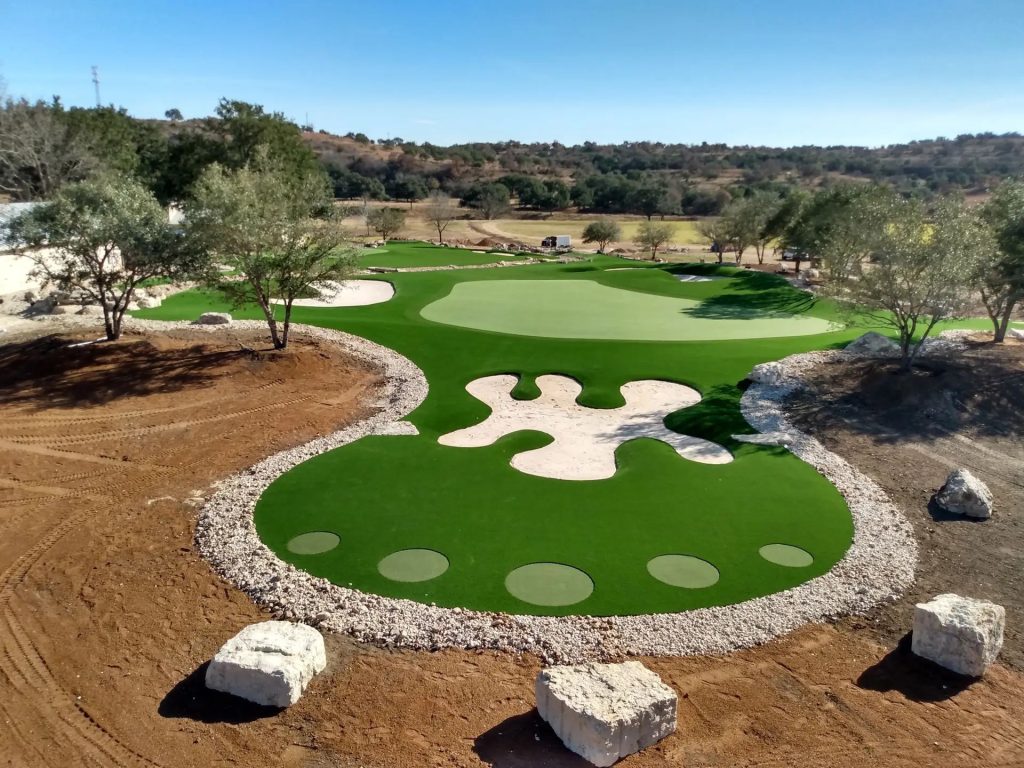
    Golf Course Engineering Consultancy

    Development, Repair & Retrofitting Solutions

    Golf courses are specialized civil and landscape infrastructures requiring precise engineering, sustainable design, and long-term performance planning. Our engineering consultancy provides end-to-end solutions for golf course development, repair, and retrofitting, combining technical expertise with environmental responsibility and international best practices.


    Our Golf Course Engineering Services

    Golf Course Development

    We provide comprehensive engineering services for new golf course projects, from concept to commissioning.

    Our services include:

    • Site feasibility study and land assessment
    • Topographic survey and contour planning
    • Master planning and course layout engineering
    • Earthwork, grading, and shaping design
    • Surface and subsurface drainage systems
    • Automated irrigation system design
    • Cart paths, bridges, and service infrastructure
    • Turfgrass selection and establishment planning

    Our approach ensures optimal playability, efficient drainage, and long-term durability.


    Golf Course Repair & Rehabilitation

    Existing golf courses often suffer from drainage failure, turf degradation, and aging infrastructure. We specialize in restoring performance while minimizing disruption to operations.

    Key rehabilitation services:

    • Condition assessment of greens, fairways, and bunkers
    • Drainage failure diagnosis and corrective design
    • Re-grading and surface leveling
    • Bunker repair and erosion control
    • Turf restoration and soil improvement
    • Irrigation system repair and optimization

    Golf Course Retrofitting & Modernization

    We upgrade aging golf courses to meet modern standards of sustainability, efficiency, and climate resilience.

    Retrofitting solutions include:

    • Flood mitigation and advanced drainage retrofitting
    • Smart irrigation systems and water-saving technologies
    • Climate-resilient and low-maintenance turf replacement
    • Structural strengthening of cart paths and bridges
    • Water harvesting and reuse systems
    • Sustainable landscaping and naturalization

    Our Engineering Approach

    Integrated Planning

    We combine civil engineering, hydraulic design, landscape planning, and turf science into a single coordinated solution.

    Sustainable Design

    Our designs focus on water conservation, reduced maintenance costs, and environmental compliance.

    Lifecycle Performance

    Every solution is evaluated for long-term durability, operational efficiency, and cost-effectiveness.


    Why Choose Our Consultancy?

    • Specialized golf course engineering expertise
    • International design standards and best practices
    • Customized solutions based on site conditions
    • Strong focus on sustainability and resilience
    • Proven experience in complex outdoor infrastructure

    Technical Capabilities

    • Golf course grading and earthwork design
    • Drainage and stormwater management
    • Irrigation system hydraulic modeling
    • Turf root-zone and soil engineering
    • Erosion control and slope stabilization
    • Construction supervision and quality control

    Industries & Clients We Serve

    • Private and resort golf courses
    • Country clubs and sports authorities
    • Real estate and hospitality developers
    • Government and institutional clients

    Project Delivery & Support

    We support our clients through every stage of the project:

    • Feasibility and concept design
    • Detailed engineering and tender documentation
    • Construction supervision and QA/QC
    • Commissioning and post-project support

    Commitment to Sustainability

    Our golf course engineering solutions promote:

    • Efficient water usage
    • Reduced chemical dependency
    • Climate-adaptive infrastructure
    • Preservation of natural ecosystems

    Contact Us

    Looking to develop, rehabilitate, or modernize a golf course?
    Our engineering team is ready to deliver efficient, sustainable, and high-performance golf course solutions.

    📩 Contact us today to discuss your project requirements.


    SEO Keywords Integrated

    Golf course engineering consultancy, golf course development, golf course construction engineering, golf course repair, golf course retrofitting, golf course drainage design, golf course irrigation system, sustainable golf course design.

  • Recent Earthquake in Bangladesh – LIVE or LEAVE?

    Earthquake in Bangladesh • Dhaka Earthquake • Seismic Risk • BNBC 2020 • Fault Lines


    Recent Earthquake in Bangladesh — Live or Leave?

    On 21 November 2025, Bangladesh woke up to one of the strongest earthquakes in recent years. For 26 seconds, millions felt the ground shake, buildings sway, and fear rise in their chest. Offices came to a standstill, parents grabbed their children, and everyone asked the same question:

    👉 “Are we safe here?”
    👉 “Should we leave Dhaka?”

    This article breaks down the quake, the science, the emotions, and the realistic decisions ordinary people face today.


    🔶 What Exactly Happened on 21 November 2025?

    A Sudden 5.7 Magnitude Quake

    • Time: 10:38 a.m. BST
    • Magnitude: 5.7
    • Epicenter: Madhabdi, Narsingdi (very close to Dhaka)
    • Depth: ~10 km (shallow = stronger shaking)

    This wasn’t a distant tremor.
    It was a Bangladesh-centered, shallow, high-intensity shake.

    Damage & Casualties Reported

    • 5–10 deaths (varies by source)
    • Over 100–600 injuries
    • Structural damage in Dhaka, Gazipur & Narsingdi
    • Cracks in buildings, broken walls, falling objects
    • Panic evacuation from high-rises

    Aftershocks That Triggered More Panic

    Within hours:

    • A 3.3 magnitude tremor
    • A 4.3 magnitude tremor
    • Several micro-aftershocks

    People stayed outside for hours, afraid of returning to their homes.


    🔶 Bangladesh’s Seismic Reality: A Wake-Up Call

    Many experts are saying it outright:

    Bangladesh stands on major active faults, including:

    • Madhupur Fault
    • Dauki Fault
    • Plate boundary near the Himalayas

    BNBC 2020 places Bangladesh in Seismic Zones 2, 3, and 4 — with Dhaka in moderate to high risk.

    The UN recently declared Bangladesh as one of the world’s most vulnerable earthquake zones.

    So the big question becomes…


    ⚠️ Should You LIVE Here… or LEAVE?


    1. This Was NOT a Catastrophic Earthquake

    A magnitude 5.7 will shake buildings but will not level a city.

    It was serious — but survivable.

    2. Preparedness Works (Ask Japan)

    Countries with frequent earthquakes stay safe because:

    • Buildings are designed correctly
    • Codes are enforced
    • People know what to do

    Bangladesh can learn and adapt.

    3. Realistically, People Cannot Just Leave

    You can’t abandon:

    • Jobs
    • Schools
    • Homes
    • Family roots

    Most people will stay.
    So staying safely is the goal — not escaping.


    ❌ Reasons Some Should Consider LEAVING Certain Buildings or Areas

    1. Old Buildings = Real Danger

    If you live in:

    • Old Dhaka
    • Non-engineered buildings
    • Structures older than 25–30 years
    • Buildings without BNBC seismic design

    You are at higher risk.

    2. Unauthorized or Weak High-Rises

    Thousands of buildings were made without:

    • Proper foundation
    • Shear walls
    • Quality concrete
    • Column-beam integrity

    A larger earthquake could be devastating.

    3. Expert Warning of a Potential Larger Quake

    If your area is structurally unsafe, relocating to a safer building (even temporarily) is wise.


    🔶 What YOU Should Do Now (Practical + Life-Saving)

    1. Inspect Your Building

    Ask a structural engineer to check:

    • Cracks
    • Column sizes
    • Beam depths
    • Foundation design
    • BNBC compliance

    2. Create a Family Earthquake Plan

    Agree on:

    • Safe room spots
    • Exit route
    • Emergency contact numbers
    • Meeting point outside

    3. Office & Schools Must Conduct Drills

    No more ignoring it.

    4. The Government Must Enforce BNBC 2020

    No more shortcuts, no more “manage kore dibo.”

    Lives > profit.

    5. Learn Life-Saving Basics

    Teach your family:

    • Drop, Cover, Hold
    • Staying away from elevators
    • Being aware of weak columns

    🔶 Final Answer: Live or Leave?

    Here’s the truth:

    Most people will continue living here.

    And that is fine — if we learn from this.

    Earthquakes can’t be stopped.
    But deaths can.

    The recent quake was not the disaster.
    The disaster will be if we don’t prepare for the next one.


    📌 Call-to-Action (For Your WordPress Blog)

    🔹 Want to know if your building is safe?
    Comment below or message to get a free initial structural screening checklist.

    🔹 Want an article on BNBC 2020 Earthquake Requirements?
    I can write a full guide for your blog.

    🔹 Want a downloadable Earthquake Safety Poster for your office/home?
    I can generate one instantly.